The Vertical Slice Engine
The shortest path from hypothesis to working software is not faster sprints. It is an architectural decision. The engineering teams that consistently ship demonstrable value in days, not months, organise their code by business capability, not by technical layer. This is the pattern they follow.
Late-Stage Integration Risk
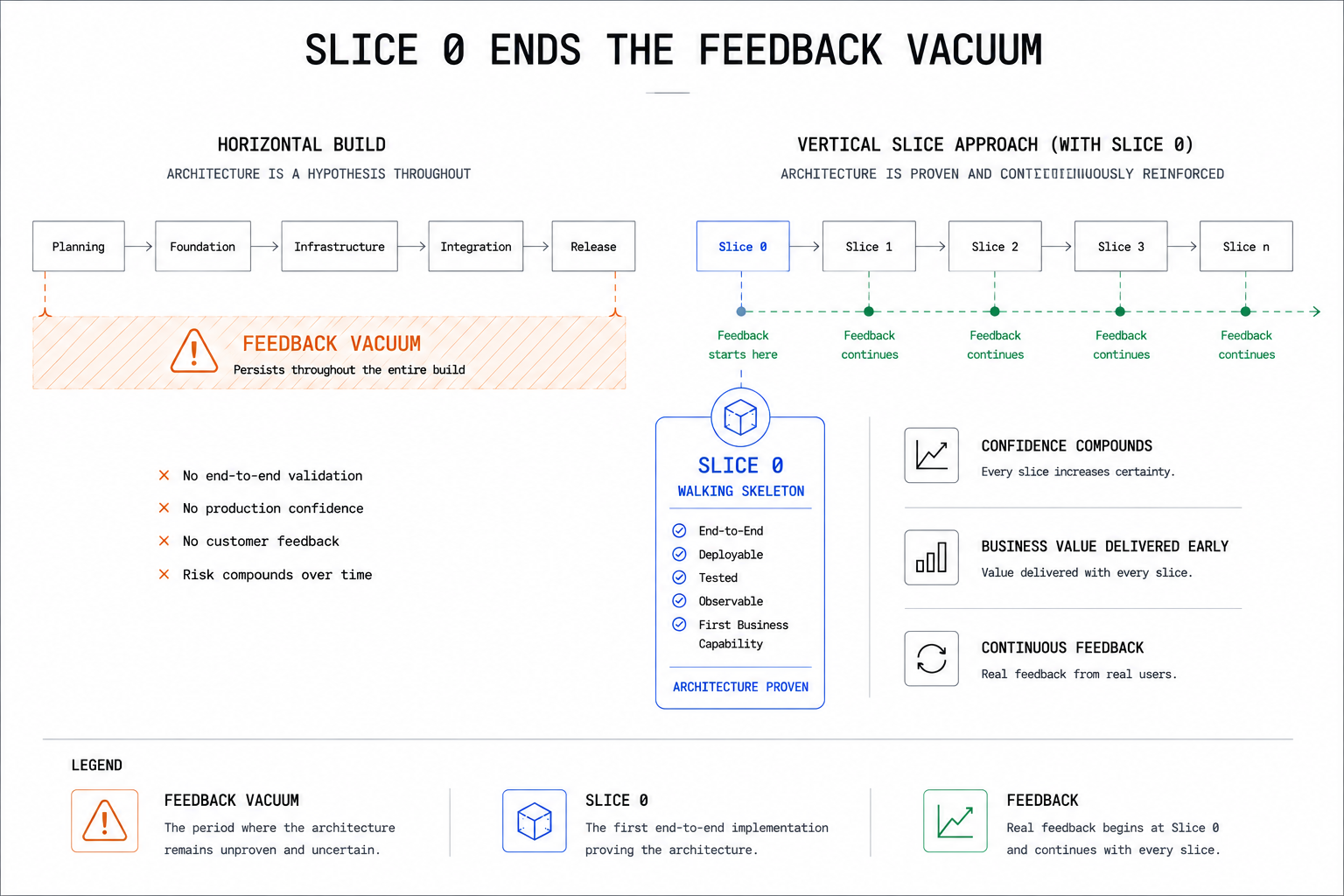
Many engineering teams build software horizontally. The team designs the schema first, builds the API against it, then assembles the user interface on top. Each technical layer is considered complete before the next begins. This approach looks like engineering rigour. What it produces is a Feedback Vacuum.
A Feedback Vacuum is the condition in which a team spends weeks, sometimes months, building software with no mechanism for discovering whether what they are building is correct. There are no real users. There is no working product. There is only the compounding assumption that each layer is accurate, built upon the assumption that preceded it.
The structural consequence is Late-Stage Integration Risk. When the three layers are finally assembled, typically at week ten of a twelve-week engagement, the team discovers that the data shape the UI requires does not match the schema designed in week one. The API contracts do not reflect the interactions a real user needs. The architecture is wrong at every layer simultaneously. Horizontal builds rarely fail to produce software. They consistently produce the wrong software, at the wrong cost, at the wrong time.
The cost is not the week-ten failure itself. The cost is the ten weeks of compounding commitment to an unvalidated design. By the time the integration fails, the team has:
- Built a data schema against a product hypothesis no user has validated
- Written a service layer whose contracts are entirely determined by that unvalidated schema
- Spent sprint capacity on a presentation layer whose interaction model has never been tested by a real user
- Created
Layer-Hoppingcoupling: a single domain concept change now propagates across all three layers simultaneously - Assembled
Integration Risksilently, compounding it with every passing week
In an enterprise with an eighteen-month delivery cycle, this is survivable. In a startup with eight weeks of runway, it is the end of the company.
Feature-First Encapsulation
The Vertical Slice Engine inverts the build sequence. Instead of constructing technical layers in isolation, the team defines and delivers complete, end-to-end business capabilities. Each Vertical Slice is a Bounded Context in the domain-driven sense: it owns its presentation, its business logic, and its data access. Nothing leaks across its boundary without a deliberate, explicit contract.
This is High Cohesion, Low Coupling applied at the feature level. Code that belongs to "Create Invoice" lives in one place. Code that belongs to "Process Payment" lives in another. Each slice is an encapsulated Value Stream: it takes a user's intent as input and produces a business outcome as output, handling every layer of that transformation within its own boundary. When a product change affects "Create Invoice," exactly one module changes. The regression surface is contained. The review is predictable.
The failure mode this eliminates has a name: Layer-Hopping. It occurs when a single business change (adding a field, renaming a status) requires coordinated edits across five files in three technical directories. It is the primary driver of merge conflicts, slow code review cycles, and sprint overflow in early-stage teams. It is an architectural problem, not a process problem.
Teams structured around layers produce layer-shaped software: efficient to build in isolation, expensive to integrate. The structure of a team follows the structure of its architecture, not the other way around. When you organise by technical role, you get technical-role-shaped thinking. When you organise by business capability, you get business-capability-shaped output: features that are complete, ownable, and deployable independently.
Slice 0 is not chosen for its business value. It is chosen for its Integration Risk. The team identifies the feature that, if it fails to work end-to-end, makes the entire product architecture invalid. That feature is built first, within 7 to 10 days, as a complete Bounded Context, deployed to a real URL, validated by a real user. In architectural literature this is called a Walking Skeleton: a thin but complete implementation that exercises every layer of the system (UI, logic, data, deployment) and proves the architecture holds before the team commits to building on top of it.
If Slice 0 works: the architecture is proven. The Encapsulation pattern holds. The team commits and begins Slice 1. The codebase now has a canonical structural precedent: each business capability is a self-contained module, responsible for its own Value Stream from input to outcome.
If Slice 0 exposes a design flaw: the cost of correction is a week's work. Not five months of rework across three entangled layers.
The Evolution Path. A codebase built from vertical slices is, by definition, a Modular Monolith, the only architecture that can transition to microservices without a rewrite. Each Bounded Context already has a defined interface and a clear ownership boundary. When the business scales to the point where the "Payments" capability requires independent deployment and scaling, it becomes the payments service. The "Notifications" Bounded Context becomes the notifications service. There is no strangler-fig migration. No big-bang re-architecture. The carve-out is a deployment decision. The structural work was done on Day 10.
Every subsequent slice follows the same discipline: define the scope as a business capability, build end-to-end within its Bounded Context, validate with an acceptance test, deploy to a shareable staging URL, collect real user feedback, then begin the next slice. Architecture decisions are never made in the abstract. They are made against evidence from a working system.
The Blueprint
Three views of the same decision: how the codebase is structured, how a slice is delivered from identification to deployment, and how that changes the feedback dynamic across the full build.
1 · Codebase Structure
The most visible consequence of the pattern is the directory tree. In a horizontal build the tree is organised by technical role: every feature's logic is mixed inside the same /services/ directory. In a vertical build the tree is organised by business capability: every file that belongs to "Invoicing" lives in one place.
/src
  /controllers
    invoice.js
    payment.js
    user.js
  /services
    invoice.js
    payment.js
    user.js
  /models
    invoice.js
    payment.js
    user.js
  /routes
    index.js
A change to Invoicing touches 3+ directories. Code review spans the entire codebase.
/src
  /features
    /invoicing
      InvoiceForm.jsx
      invoiceService.js
      invoiceSchema.sql
      invoice.test.js
    /payments
      PaymentGateway.jsx
      paymentService.js
      paymentSchema.sql
      payment.test.js
A change to Invoicing touches 1 directory. Ownership is unambiguous. Review is scoped.
2 · Slice Delivery Sequence
Every slice, starting from Slice 0, follows the same five-step sequence. The acceptance gate at step 4 is not optional: the next slice does not start until it passes.
-
1Identify the slice. Define the business capability as a single user intent: "a user can create an invoice." Scope it to the narrowest end-to-end path that exercises a real user need. For
Slice 0, pick the feature with the highestIntegration Risk, not the lowest complexity. -
2Build end-to-end inside one boundary. Write the UI, the business logic, and the data access together, inside a single feature directory. No shared service layer. No shared model. If another slice needs the same data, it gets its own representation of it.
-
3Deploy to a shareable URL. Every slice lands on a live staging environment before it is merged. This URL is sent to a real user or stakeholder for validation, not a teammate or product manager viewing a Figma mock. The staging URL is the evidence that the slice works end-to-end on infrastructure identical to production.
-
4Pass the acceptance gate. An automated end-to-end test suite runs against the staging URL in CI. It exercises the feature from the UI through to the database and asserts the business outcome. A slice is not complete until this gate passes. Failure here is a day-one cost, not a week-ten cost.
-
5Merge and begin the next slice. The codebase now has a proven, canonical precedent for how a slice is structured. The next slice follows the same pattern. Confidence compounds. Architecture decisions are made against a working system, not a whiteboard.
3 · The Feedback Contrast
The structural and procedural differences above produce a single measurable outcome: the Feedback Vacuum ends at Slice 0 instead of at release. Below is what that looks like across the full build timeline.
What a framework must support
The Vertical Slice Engine is framework-agnostic: it is an organisational principle, not a technology prescription. However, not all frameworks make Bounded Context encapsulation straightforward. Some actively resist it by enforcing layer-based project structures. The following criteria define what the chosen stack must support in order to allow slice-based delivery without fighting the framework's own conventions at every turn.
| Concern | Requirement | Why it matters |
|---|---|---|
| module organisation | Feature-based directory structure | The framework must allow code to be grouped by business capability, not by technical role. A directory named /features/invoicing/ that contains its own presentation, logic, and data access is the target structure. Frameworks that enforce a rigid /controllers/ /services/ /models/ split actively prevent this and should be overridden or avoided. High Cohesion, Low Coupling must be expressible in the directory tree. |
| schema management | Per-slice, version-controlled migrations | Each slice must be able to introduce its own schema changes without coupling to other slices' data models. Migrations must be version-controlled alongside application code, not managed separately through a GUI or a shared schema file that requires coordination. This ensures that a slice is truly self-contained and can be reviewed, reverted, and audited independently. A shared god schema is a horizontal build's data model wearing different clothes. |
| deployment model | Preview environments per branch | Every slice must be deployable to a shareable URL before it is merged into the main branch. This URL is the validation surface for real users and stakeholders. Without it, the team is back to demonstrating features on a local machine, which is a presentation, not a validation. The deployment model must produce a live URL on every pull request, automatically, without manual environment management. |
| acceptance testing | End-to-end tests in CI against the preview environment | The exit condition for each slice is a passing end-to-end test suite that exercises the feature from the user interface through to the database, running automatically in CI against the live preview URL. A slice is not complete, and the next slice does not begin, until this gate passes. Unit tests are insufficient: they validate code in isolation, not the integration between layers. The acceptance test is the only evidence that all three layers of the slice are functioning as a coherent system. |
A codebase organised by feature slice is inherently audit-ready. When a technical due-diligence review occurs, an auditor can navigate to /features/payments/ and find every relevant component (the user interface, the business rules, the data schema, and the tests) in one place. Business logic is not scattered across a generalised services layer that has accumulated concerns from every domain of the application. This structure signals engineering maturity to a technical reviewer more clearly than any architecture diagram.
What Best-in-Class Teams Learned
The most instructive source of architectural wisdom is not academic literature. It is the post-mortem of a growth-stage startup that survived to Series B. The governance decisions below represent the commitments that distinguish engineering organisations that scale cleanly from those that accumulate structural debt faster than they ship features.
Big Design Up Front is a holdover from enterprise environments where delivery cycles are measured in years and the cost of discovering a design flaw mid-programme can trigger a re-plan worth millions. At that scale, spending three months on architecture before writing a line of production code is a rational hedge. At a startup, it is the same three months the market used to outmanoeuvre you.
The Vertical Slice Engine does not eliminate design. It defers commitment to design until there is evidence, from a working system with real users, that the design is correct. Slice 0 is not a prototype. It is a controlled architectural experiment with a binary outcome: the architecture holds, or it does not. Either result is valuable. Only the second result is expensive, and in this model, it costs a sprint, not five months.
Governance positions
Avoid Shared Global Models
The instinct when building rapidly is to create a User model, an Order model, a Product model, all generic and shared across the entire system. This is the first wrong abstraction. A User model touched by six features is coupling those six features through their data layer. When feature three requires User to mean something different, because the business has evolved, that change propagates invisibly to the other five. The resulting Integration Risk is indistinguishable from the horizontal build's week-ten failure. It simply arrives later, when the codebase is larger and the team is bigger. Each Bounded Context should own its own representation of the domain entities it operates on, even if those representations initially look identical.
Resist Premature Abstraction in the 0-to-1 Phase
The principle, embedded in the engineering cultures of organisations from Basecamp to Netflix, is precise: duplication is cheaper than the wrong abstraction. In the 0-to-1 phase, two slices sharing identical-looking logic are not a problem. They are two separate experiments. The cost of that duplication is near zero. The cost of abstracting that logic prematurely, before the product has settled on what it needs, is an architectural refactor during the worst possible moment: when the product is finding its market. The correct time to abstract is after the pattern has appeared in three or more slices and the business rules have stabilised. Not before.
Slice 0 requires senior architectural judgement
Selecting the correct feature for Slice 0 is not a planning exercise. It is an act of architectural risk assessment. The instinct of most teams is to begin with a low-complexity feature. This is precisely wrong. Slice 0 must be the feature whose failure would invalidate the entire product architecture. Identifying that feature correctly requires the experience of a principal engineer or a seasoned technical lead who can read the Integration Risk map of the system before a line of code is written. A team without that judgement will choose the wrong slice and produce a false positive: an architecture that appears validated but has not been tested against its highest-risk assumption.
Three criteria that identify the correct Slice 0 candidate:
- Crosses the most integration boundaries. The feature that touches UI, API, database, and at least one external dependency simultaneously. If this handshake works, the majority of your integration surface is proven.
- Exercises the most novel part of the stack. If you are using an unfamiliar framework, a new data model pattern, or an external API your team has not integrated before: the feature that depends on that choice is your
Slice 0. Defer it and you defer the discovery of every assumption that surrounds it. - Would cause the most rework if it were wrong. Ask: if the data model this feature introduces turned out to be incorrect, how many other features would need to change? The feature with the highest answer is the one that must be validated first.
Capital Efficiency
Every week of engineering spend that produces no demonstrable output is a week of runway converted into Integration Debt. These are the outcomes teams following this pattern consistently see.
Late-stage integration failures that cost £30k–£100k to resolve at Week 10 are surfaced on Day 10, when the cost of correction is one week of senior time. Bounded Context encapsulation contains the risk structurally.
Slice 0 is deployed to a shareable staging URL within 10 days. A real user validates the core workflow, not a wireframe, not a mock, not a prototype. The feature is real, the data is real, the validation is real.
Each completed slice produces a working URL. When investors ask "what did the engineering team build this week?", the answer is a live demonstration, not a slide. Progress is tangible and verifiable from Week 1.
Because each slice is an encapsulated Bounded Context, changing one feature does not cascade through the platform. The pivot cost is scoped to the slice. The rest of the product ships while the pivot is in progress.
From Day 10, a working product exists at a shareable URL. More critically, the codebase is audit-ready: business logic is co-located with the feature it belongs to, not scattered across a generalised services layer. A technical due-diligence reviewer will find this immediately.
The Modular Monolith produced by this pattern is the only starting architecture with a defined path to microservices. Bounded Contexts become independent services when the business demands it, not through a rewrite but through a deployment decision.
Is this the right pattern for your project?
This pattern fits when
You are building a net-new product and have not yet committed to an architecture or stack
The product requires user validation before further engineering investment (pre-seed or seed stage)
You have a senior engineer or technical partner who can identify the correct Slice 0 candidate
Speed to a working demo is more important than completeness. You need something real in investors' hands within two weeks
This pattern does not fit when
You are adding features to an established codebase with an existing architecture: this pattern applies to greenfield work
The product is infrastructure-first, e.g. a data pipeline or platform component with no user-facing interface to validate against
Regulatory or compliance constraints require the full data model and security review to be completed before any feature can be built
No CI/CD pipeline exists and there is no plan to establish one: the pattern's acceptance test gate cannot be enforced without automated deployment and a mechanism to run end-to-end tests against a live environment on each pull request