Outcome-Based Estimation
The hour is no longer a proxy for progress. When coding agents can generate a thousand lines of boilerplate in minutes, billing for time is billing for the mechanism, not the outcome. This blueprint documents an alternative approach.
The Billable Hour: A Legacy of Manual Labour
The billable hour is a construct inherited from professional services built on manual labour. A solicitor's hour, a consultant's hour, a contractor's hour: each represents a unit of attention applied to a problem. The logic holds as long as effort and output maintain a linear relationship: more hours in, more progress out.
Coding agents have broken that linearity.
A senior engineer directing Cursor, GitHub Copilot, or Claude Code can produce a complete, tested authentication module in forty minutes that would have taken a junior developer four days. The input (time) has collapsed. The output (functional software) has not. The ratio between effort and outcome has fundamentally shifted. Yet most engineering engagements continue to price the effort rather than the outcome.
This is the Time-Tax Trap: charging for the mechanism when the client is purchasing the result.
The structural problem this creates is Billability Theatre: a condition in which engineering progress is measured by logged hours rather than verified functional outcomes. A team can spend forty hours producing a landing page that a developer equipped with modern agent tooling can produce in four. The client receives an identical asset. The time delta is pure extraction from the engagement. It produces no additional value; it simply inflates the cost of the mechanism.
Traditional hour-based models were designed to manage risk for the consultant, not to deliver capital efficiency for the founder. In a manual-labour environment, the hour was the only observable proxy for work in progress. In an AI-native environment, it is simply the wrong unit of measurement.
The cost is not any individual invoice. The cost is the structural incentive the hour creates: the longer it takes, the more the consultant earns. Agent-Assisted Velocity inverts this. The faster TechTek delivers a verified outcome, the better the outcome for the client, and the better the signal about the team's architectural efficiency. A fee model built on hours actively penalises this efficiency. The OBE model rewards it.
Labour-Logic Decoupling
The fix is not a discount. It is a different unit of measurement altogether. The Outcome-Based Estimation model replaces the hour with the Verified Outcome. A project is decomposed into discrete, auditable functional assets, each defined not by the work required to produce it, but by the state transition it represents in the product.
A state transition reads: "User authentication does not exist → Functional auth layer, deployed, tested, accepted." The fee attaches to the transition. Not to the minutes spent traversing it.
This is Labour-Logic Decoupling: structurally disconnecting the fee from the manual labour input and attaching it to the verified functional output. It is not a pricing preference. It is a governance decision that changes the incentive structure of the entire engagement.
Three mechanisms make the OBE model operational:
-
1Outcome Mapping. Before any code is written, each deliverable is defined as a discrete
Verified Outcome: a named state transition from "does not exist" to "deployed, tested, accepted." These outcomes form the contract. There are no open-ended work items, no undefined deliverables, no retrospective scope negotiations. The boundary of each outcome is set before the engagement begins. -
2Complexity Scoring. Each outcome is assigned a complexity score based on the architectural guidance required to lead an agent to that outcome, not the time spent generating code. A standard authentication flow requires minimal architectural judgment. A proprietary vector-search optimisation requires significant senior reasoning. The fee scales with the judgment, not the keystrokes.
-
3Validation Gate. The exit condition for each outcome is a pass from an automated evaluation harness, not a client review meeting, not a demo, not a visual inspection. For product code: Vitest or Playwright end-to-end tests running against a live preview URL. For AI and RAG pipelines: Ragas or DeepEval scoring against a defined benchmark. The gate is binary. Pass means the outcome is complete. Fail means it is not.
This model maps directly to TechTek's Fixed Base + Success Premium pricing structure. The base fee covers architectural guidance and delivery infrastructure. The success premium triggers when the client's defined business outcomes are achieved, not when hours are logged.
The Delivery Pipeline: From Outcome to Verified Outcome
Six sequential steps. No parallel swim lanes, no open milestones. Each step is an input gate for the next. It must produce an auditable artefact before the following step begins. What makes this structurally different from a traditional project plan is that neither the client nor the delivery team can proceed without evidence at every transition.
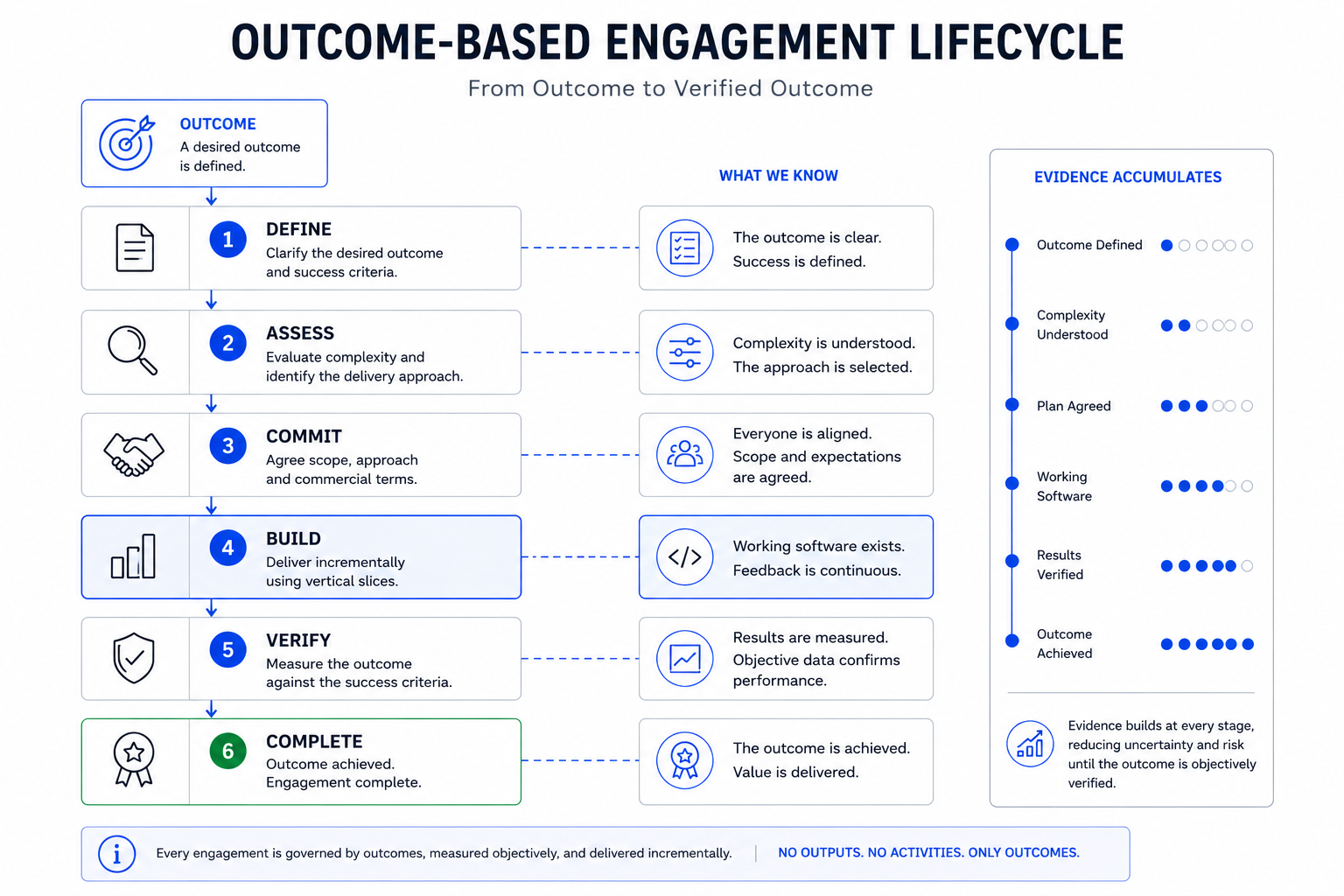
The pipeline has one structural property the legacy model lacks: every step produces evidence. Define produces a clear outcome statement with agreed success criteria. Assess produces a written complexity score and confirms the delivery approach. Commit locks scope, approach, and commercial terms before a line of code is written. Build produces a deployable artefact at each incremental vertical slice. Verify produces a binary pass/fail on objective data, triggering the variable fee on outcomes, not assertions. Complete closes the engagement against the original outcome definition. At no point does the client have to take the team's word for progress.
A typical scoping session runs 90 minutes. We take your product brief, decompose it into Verified Outcomes, assess each item's complexity, and confirm the delivery approach. The result is a fixed-fee proposal delivered within 48 hours. No retainer, no discovery phase billed separately, no re-estimation mechanism once the scope is signed.
The Assess Step: Complexity Routing in Practice
The Assess step routes each piece of work into one of two channels based on the architectural guidance required to produce a Verified Outcome. The channel determines who leads, which tools are used, and what the timeline looks like, not the complexity of the code itself.
Standard functionality with established patterns. Authentication flows, CRUD operations, landing pages, standard API integrations, dashboard layouts.
Novel problems with no established pattern. Proprietary algorithms, custom AI evaluation harnesses, multi-tenant isolation strategies, domain-specific optimisations.
The distinction is not about the volume of code. It is about the irreducibility of the judgment required. Commodity logic can be guided to completion by a well-prompted agent. Core business logic requires a human who can reason about the problem space, evaluate trade-offs the agent cannot see, and make architectural decisions that will outlast the current sprint.
| Outcome | Channel | Legacy (Hours) | OBE (Outcome Slice) |
|---|---|---|---|
| SaaS Landing Page | Commodity | ~40 hrs |
1 Outcome Slice · Low Complexity Delivered in 3–4 hours via v0.dev + Cursor. Senior review and acceptance testing included. Fee set at scoping, not linked to generation time. |
| Agentic RAG Pipeline | Core Logic | ~120 hrs |
1 Outcome Slice · High Complexity 2 weeks of senior-led R&D. Ragas evaluation harness defines the acceptance gate. Complexity score reflects the architectural judgment required, not hours of code generation. |
| Auth & RBAC Module | Commodity | ~25 hrs |
1 Outcome Slice · Low Complexity Agent generates to established pattern. Senior engineer reviews security posture and acceptance-tests against Playwright E2E suite. Delivered in 4–6 hours. |
| Multi-Tenant Isolation | Core Logic | ~80 hrs |
1 Outcome Slice · High Complexity Architectural decision about isolation strategy (row-level security vs schema-per-tenant vs separate databases) cannot be delegated to an agent. Senior architect defines the model. Agent implements to the decision. |
Why Agent-Assisted Velocity Requires More Oversight, Not Less
The most common misconception about agentic engineering is that higher generation speed reduces the need for senior oversight. The opposite is true. A coding agent can produce five hundred lines of structurally plausible code in ninety seconds: code that compiles, passes linting, and looks correct on inspection. That same code may contain architectural decisions that accumulate Hidden Technical Debt at a rate no manual team could match, precisely because the rate of generation is so high.
The governance positions below are not optional constraints on the OBE model. They are load-bearing elements of it. Remove any one of them and the model produces fast-generated software that is technically unsound and commercially misaligned.
Governance positions
Senior Review Depth Scales With Generation Speed
The faster an agent generates code, the more senior review time is required per unit of output, not less. An agent that produces a complete feature in four hours has also produced four hours of architectural decisions that a junior engineer might not catch and a senior engineer absolutely must. The OBE model builds senior review time into the Complexity Score of every outcome, regardless of which channel the work flows through. Agent-Assisted Velocity is not a cost reduction in senior time. It is a reallocation of senior time from generation to review, validation, and architectural governance.
Outcome Contracts Prevent Scope Erosion
When the deliverable is measured in hours, scope is structurally impossible to fix. A client can request a revision at any point in the engagement and each request is absorbed as additional time. When the deliverable is a Verified Outcome defined by acceptance gate conditions, scope is fixed by those conditions. A passing Playwright test suite either exists or it does not. There is no negotiation. Changes to scope are new outcome definitions (new contracts, new complexity scores), not additional hour blocks appended to an existing invoice. This boundary is the primary mechanism by which the OBE model eliminates scope creep.
Complexity Scoring Is Set Before Engagement, Not During
Retrospective complexity assessment ("it turned out to be more complex than we estimated") is the most common mechanism by which time-based engagements overrun. In the OBE model, Complexity Scoring happens during the scoping session, before any code is written. Once set, the fee is fixed. If a task proves more architecturally demanding than assessed, the additional cost is absorbed internally, not re-invoiced to the client. This is not charity. It is a commercial signal: if the Complexity Scoring is consistently wrong, the scoring model needs to improve. The client should not be the mechanism by which that improvement is funded.
What the Founder Gains
You stop paying for the middle (the manual generation work) and pay only for the end: the Verified Outcome. These are the structural advantages that produces.
The total engagement cost is agreed at scoping. Agent efficiency improvements mid-engagement benefit delivery velocity, not the invoice. There is no re-estimation mechanism and no "additional hours" line item.
Each completed outcome produces an auditable artefact: a deployed URL, a passing test report, an accepted pull request. Progress is observable and verifiable, not self-reported through a time-sheet or a status meeting.
Outcome contracts defined by acceptance gate conditions eliminate the mechanism by which scope creep enters hour-based engagements. Every change request becomes a new outcome definition: visible, priced, and agreed before work begins.
The client pays for verified functional assets, not for code generation activity. TechTek's use of agents, senior architects, or any combination is an internal implementation detail, irrelevant to the client's invoice.
The Success Premium component of the engagement model triggers on business outcomes, not delivery milestones. The delivery partner's commercial interest is structurally aligned with the founder's from the first day of the engagement.
Every outcome is accompanied by a passing automated test suite and a shareable deployment URL. A technical due-diligence reviewer finds auditable evidence of verified functionality, not a sprint burndown chart and a demo environment.
Is OBE the right model for your engagement?
OBE fits when
You are commissioning discrete, auditable functional assets with definable acceptance criteria, not open-ended consultancy
You want cost certainty before the engagement begins, not a running meter that produces a surprise invoice at the end
You have a technical lead or principal who can define outcome boundaries and acceptance conditions during the scoping session
You are comfortable with AI-assisted code generation as part of the delivery stack, provided senior architectural review is built into the process
OBE does not fit when
The work is open-ended research or exploratory design with no definable output state. There is no acceptance gate to write
Regulatory or compliance environments prohibit AI-assisted code generation in the delivery stack without manual sign-off at every step
The engagement is primarily senior strategic advisory with no tangible code deliverable. There is no artefact to attach an acceptance gate to
The client requires control over every tooling decision and rejects agent-assisted generation as a matter of policy. The efficiency that enables fixed-fee pricing cannot be achieved
Fit criteria match? The scoping session takes 90 minutes and produces a fixed-fee proposal. Book yours →