AI‑Native Hotel Matching
A travel marketplace was losing bookings to generic search. Guests were describing what they wanted and getting back a ranked list of star ratings. We built a matching engine that actually understands trip requirements — and explains every result.

Star ratings don't answer the question guests are actually asking.
A travel marketplace had a search problem. Guests would describe what they wanted — "somewhere quiet and boutique, central, good for working, dog-friendly" — and the platform would return a list sorted by price or star rating. The two had almost nothing to do with each other.
The standard fix is keyword filters: tick boxes for amenities, a price slider, a star range. It works at the edges but misses the middle — guests who know what kind of stay they want but can't translate it into a filter set. They'd click through five properties that technically matched, abandon the search, and book elsewhere.
The alternative — routing everything through an LLM — handles language well but breaks down at scale. A model that evaluates every property against every guest preference doesn't work when your inventory is 50,000 listings. Inference costs compound per search, and latency kills conversion.
AI understands the guest.
Logic finds the property.
Stack
The engine uses three layers. The only AI calls happen at entry and exit — nowhere else in the pipeline.
Layer 1 — Intent Parsing
The guest submits a trip preference in natural language — "boutique, quiet, central, pet-friendly, somewhere I can work." Claude Sonnet reads it and extracts structured intent: hard requirements (pet policy, location), soft preferences (vibe, quietness), and implicit constraints. One call per search, not per property.
Layer 2 — Match and Rank
The structured intent runs against the property catalogue using deterministic scoring — hard filters applied first (availability, pet policy, location radius), then weighted attributes (quietness score, workspace rating, style tag). Vector similarity handles the soft preferences. No model inference here. The engine runs across the full inventory and returns a ranked shortlist fast. This is where the cost control lives.
Layer 3 — Explanation
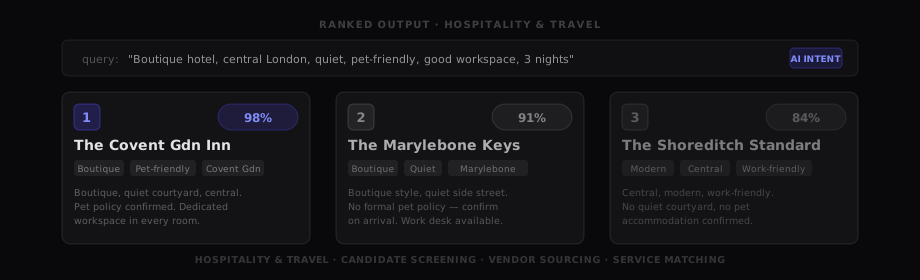
Claude Sonnet writes a plain-English reason for each property in the shortlist. Not a score. A sentence the guest can actually evaluate: "Boutique, quiet courtyard, pet policy confirmed. Dedicated workspace in every room." One call to explain all results — not one per property.
The same architecture works for any domain where a guest or buyer describes a requirement in natural language and a catalogue needs to be ranked against it. Switching verticals means loading different attribute schemas and scoring weights — not rebuilding the pipeline.
Ranked properties — with a reason, not a score
Most travel search returns a number — 8.6 out of 10, four stars, £189 per night. Guests don't know if that 8.6 reflects the thing they care about. Match AI returns a sentence: "Boutique, quiet courtyard, pet policy confirmed. Dedicated workspace in every room." The guest can evaluate that against what they asked for.
This matters for conversion. A guest who understands why a property ranked first commits faster. A guest who gets a list of scores keeps scrolling. The platform the travel marketplace ran before this had a scroll depth problem — guests were reaching page three before booking. The ranked explanation shortlist cut that significantly.
Properties can see why they ranked where they did too — which gives the marketplace a lever for quality improvement that didn't exist with a black-box score.
Defensible at
due diligence.
The architecture decisions here matter when a technical investor or acquirer looks under the hood. "We use an LLM to rank matches" invites questions about cost predictability, latency, and hallucination risk. "We use an LLM to parse intent and explain results, with deterministic ranking in between" answers all three.
Cost predictable
Two LLM calls per search regardless of catalogue size. A catalogue of 10,000 listings costs the same as a catalogue of 100.
Latency controlled
Deterministic ranking runs in milliseconds. AI calls happen at the start and end, not inside the ranking loop.
Auditable
Ranking logic is deterministic and explainable. There's no black-box model deciding who gets shown to whom.
Extensible
Add a new vertical by configuring attributes and weights. The pipeline itself doesn't change. No new models, no new training data.
Built for hospitality. The architecture runs anywhere a catalogue needs ranking.
Hospitality & Travel — built for this
Hotels, serviced apartments, guesthouses, retreats. Guest preferences and trip context matched against property attributes — vibe, quietness, workspace, pet policy. Soft preferences handled via vector similarity; hard constraints deterministically filtered. The same engine covers short breaks, business travel, and long-stay.
Candidate Screening
Job requirements in natural language. Ranked shortlist with a reason per candidate — skills, experience, and soft-fit criteria in one pass.
Vendor Sourcing
Procurement requirements, certifications, capacity, delivery constraints. The engine surfaces the right suppliers without a manual RFP process.
Service Matching
Freelancer, agency, or professional services. Scope, budget, timeline, and specialism matched against provider profiles and availability.
+ Any buyer-supplier vertical
New vertical = new attribute schema + new scoring weights. The pipeline doesn't change. Supplier vetting, equipment rental, and experience booking have all been scoped against the same architecture.
Related
Building in hospitality or travel?
30 minutes. No pitch. An honest conversation about your matching problem and whether this architecture is the right fit.